Who Is Responsible for Ads Inside an Embedded HTML5 Game?
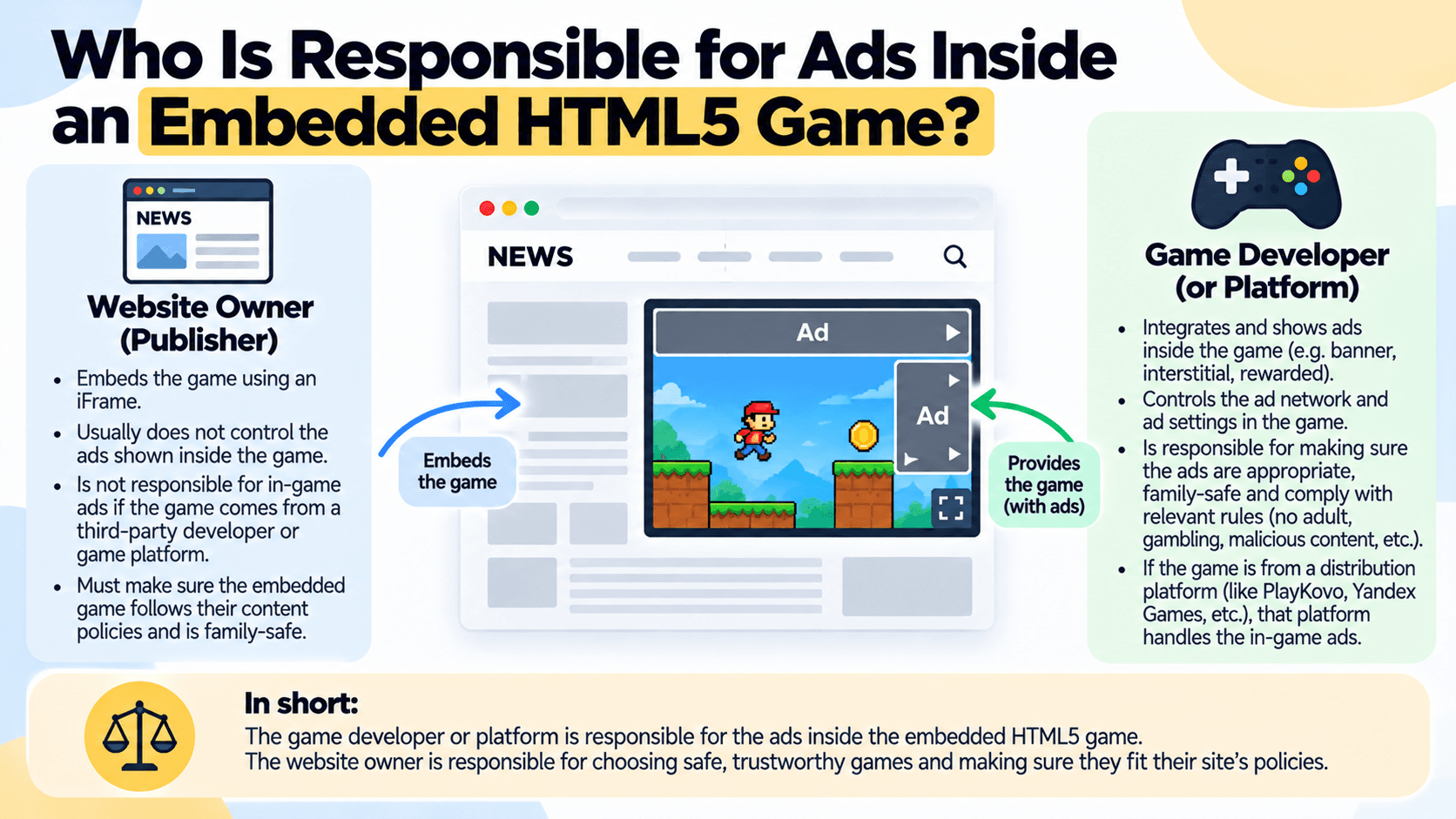
The party that hosts the game controls the ads inside it. If you embed a game from a distributor, the distributor decides what ad code runs in the frame and who gets paid. You control the page around the frame, and you stay responsible for how that page looks and behaves. This guide separates the two with sources.
The rule from Google's documentation
Google's guide to monetizing HTML5 games states a simple principle: whoever hosts the game controls the monetization of the game. It describes two cases:
- If a publisher embeds a game that the publisher itself hosts, the publisher controls the ad tag, the monetization settings and the payments.
- If a publisher links to or embeds a game hosted by a distributor, the distributor hosts the game, so it controls the tag, sets the monetization settings and decides how revenue is shared.
The same guide notes that revenue sharing for these games currently supports simple one-way shares, meaning regular AdSense payments, and that further sharing is the host's responsibility.
Who controls what in practice
| Who | Controls | Does not control |
|---|---|---|
| The game's developer | The game's design, any ad hooks built into the game, what content appears in it | Your page, where the game is hosted |
| The distributor or host | Which ad network runs in the frame, the ad settings, revenue shares, removals | The page around the frame |
| You, the publisher | The page, the placement of the frame, your own ads, the surrounding content, whether to feature the game at all | Ads inside the frame |
| Your visitor | Browser settings and extensions | The above |
The practical meaning: you cannot fix a bad ad inside a game. You can choose not to show the game.
What PlayKovo's partner terms say
PlayKovo's partner terms (September 2026 version) set rules that follow the same line:
- Ads belong to the game's host. Games may show PlayKovo's own promotions or third-party ads. You may not block, hide or replace them.
- No overlays. You may not place a button or an invisible layer over a game to capture clicks.
- No removing the referrer. The terms ask you not to add
referrerpolicy="no-referrer"to the embed, because PlayKovo recognizes your domain from the referrer. - No revenue share. The program does not include payments or a revenue share. Any future arrangement would come with separate written terms.
- Credits stay visible. You may not hide the PlayKovo brand, developer credits or licence notes.
Read the current terms before you embed. We summarize them, but only the published terms count.
What we saw loading inside a PlayKovo embed
We opened the embed pages of 90 games in Chrome 155 on 16 October 2026 with an empty cache. Every one of them loaded third-party scripts before anyone pressed play. The median first open moved about 1.61 MB, and in the whole visit a median of about 1.3 MB came from hosts other than PlayKovo's own. For the first game we checked, those hosts included an ad-serving domain of Google's ad network and a tag manager. The ad frames were visible among the frames the page opened.
This is a measurement of what loaded, not a statement about what any ad showed or earned. It does answer one question: yes, the embed page itself loads ad and analytics code, so your page inherits its weight and its privacy implications. Our page-weight guide shows how to avoid paying that cost until a visitor presses play.
Your responsibility, still
Even though you do not control the ads in a game, you still decide what your page does around it.
- Placement of your own ads. Google's AdSense guidance recommends keeping ad units at least 150 pixels from a game, because players concentrating on a game click erratically and may hit an adjacent ad. Even accidental clicks can lead to a violation notice.
- No ad before the game. AdSense does not allow ads shown for a preset time before users can reach games, videos or downloads.
- A clear play button. Do not let the page leave a visitor unsure what to press, or lure them toward ads. Google asks that play buttons be easy to spot and clickable.
- Disclosure. If your site has a consent banner, the scripts that load inside embeds are part of what visitors consent to. Describe it in your privacy policy.
- Audience fit. You cannot control what ads appear inside a frame, so decide whether the page suits the possible content. This matters most for sites aimed at children or families.
Who is responsible if something bad appears?
The sources do not give a neat legal answer, and we are not lawyers. A fair reading of the documents above:
- The party that hosts the game and its ad code is the main party responsible for what that code shows, and for its payments.
- You are responsible for the decision to embed it and for your own page. If a game keeps showing ads you consider unacceptable, the action available to you is to remove it.
- PlayKovo's terms give you a removal route: tell them via the contact on the terms, and they ask you to remove a game within three business days if there is a problem on their side.
If your site operates in a regulated area (children's content, gambling-adjacent audiences, health), get advice from someone qualified. This guide is a map of the documents, not legal advice.
A checklist before you embed any game
- Do I know who hosts the game and runs its ads?
- Do the terms say I cannot block or change them? Can I live with that?
- Is my own ad placement at least 150 pixels away?
- Is my privacy policy accurate about third-party scripts in frames?
- Do I know how to remove the game fast?
A game to see what a frame carries
Try it live · PlayKovo catalog
 DesktopsupportedMobilesupported
A free, browser-based multiplayer dogfighter set in a Minecraft-inspired voxel world. Two teams, planes, tanks, and ships, one golden ring to fight over.
Related Posts
How We Built Jolopi, a Game Portal That Runs on the PlayKovo Catalog
A developer diary on Jolopi, a visual-first HTML5 game hub fed entirely by PlayKovo's catalog JSON: the cached sync, the plain Node server, and the multilingual SEO setup, as a template for website owners.
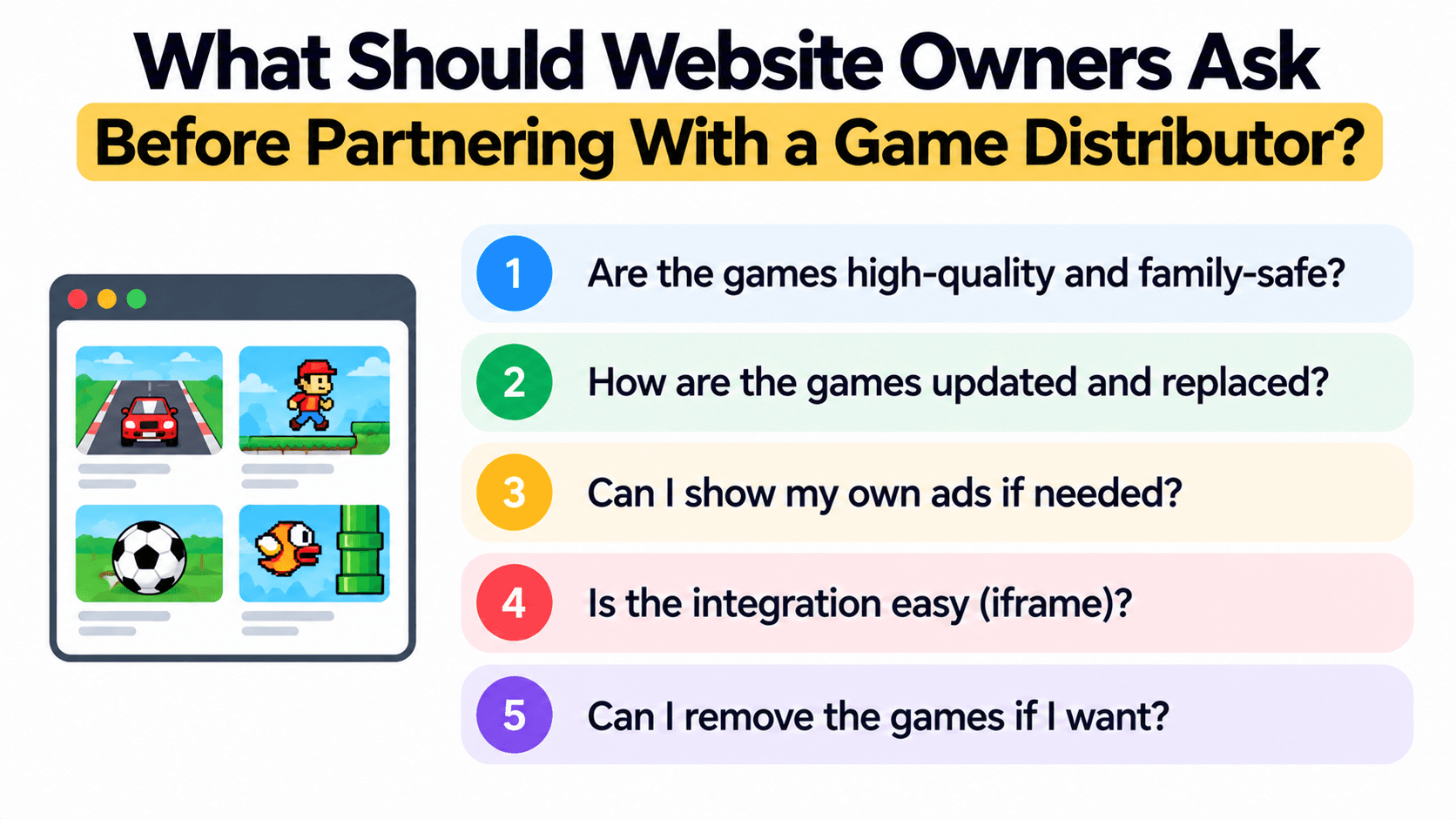
What Should Website Owners Ask Before Partnering With a Game Distributor?
Fourteen questions to put to any game distributor, grouped by what they protect, with the answer PlayKovo's published partner terms give for each one, so you can see what a clear answer looks like and compare any provider against it.
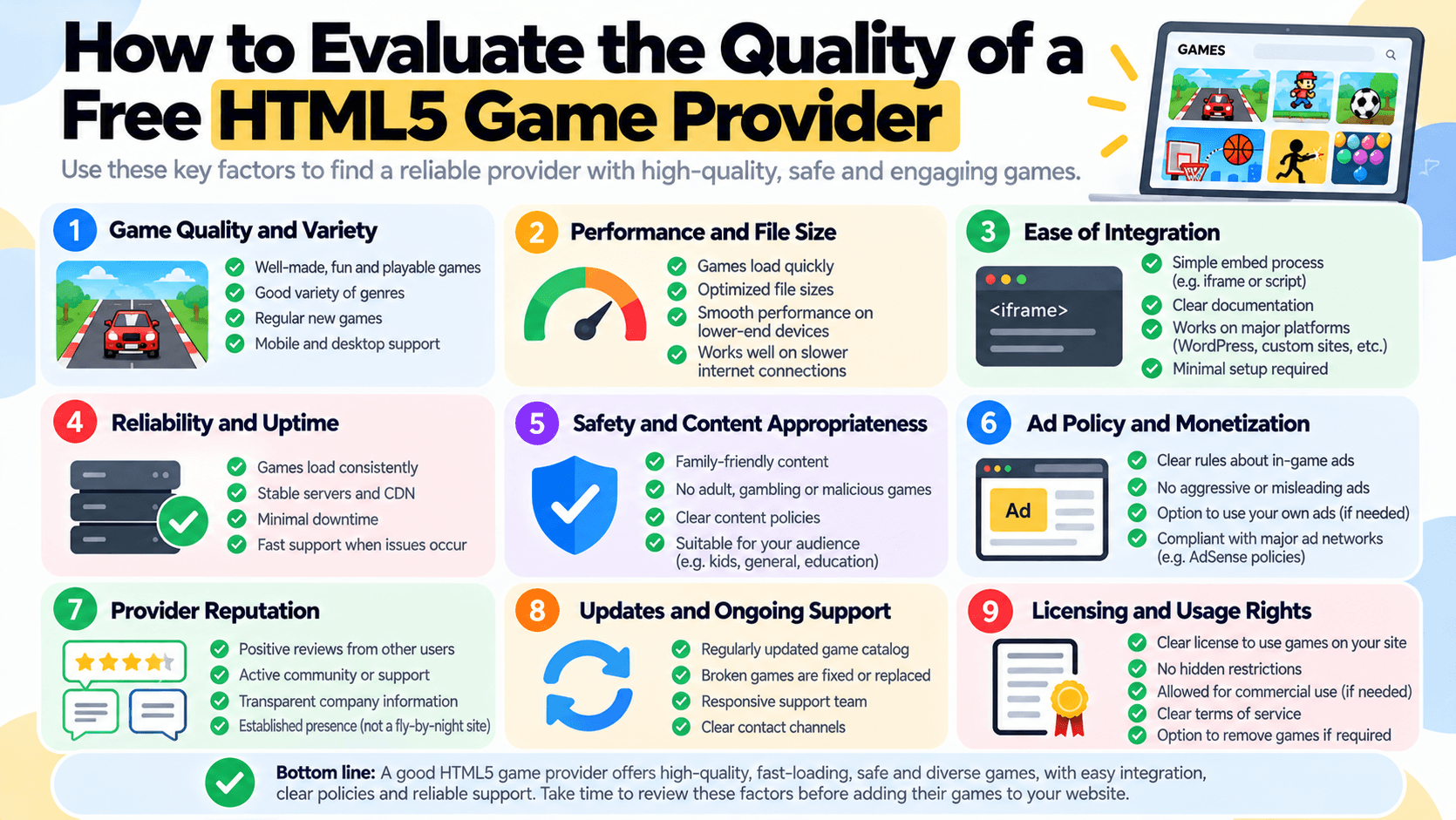
How to Evaluate the Quality of a Free HTML5 Game Provider
A weighted evaluation matrix you can copy, with tests you can run yourself for each criterion (feed completeness, embed health, framing, game weight, errors), and a worked example of the tests on PlayKovo's public feed. No competitors are scored.