How Much Maintenance Does a 100-Game Website Really Need?
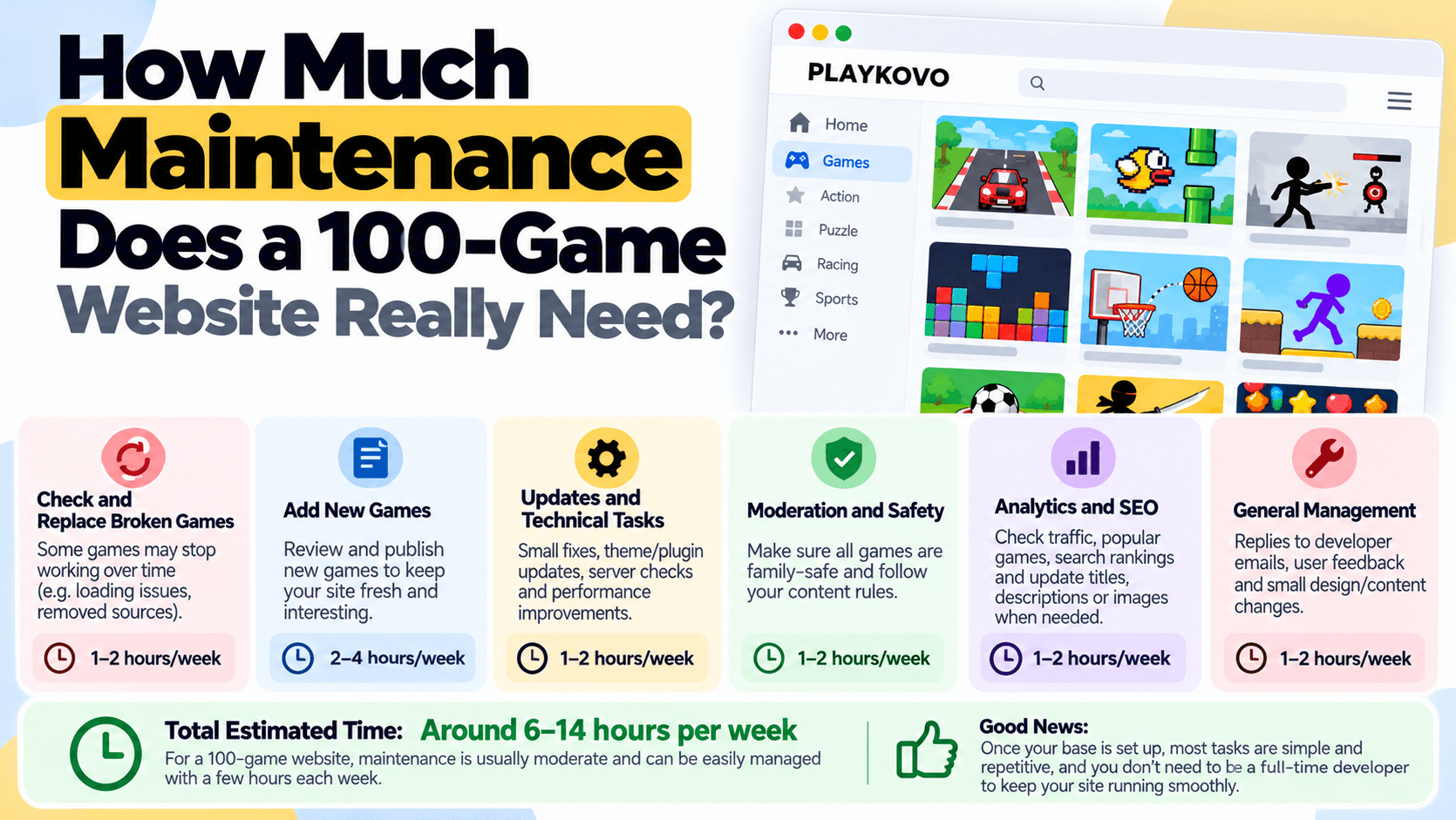
A website with 100 embedded games needs less maintenance than most people expect, because the games run on the provider's servers and update there. The work is watching: noticing removed games, broken embeds and pages nobody visits. A daily automated check does most of it, and the remaining human work fits in a few hours a month. This guide gives the plan, and is clear about which numbers are measured and which are our estimates.
What you do not maintain
With embeds, you do not host or patch game files, store assets, fix a game's bugs or pay for game bandwidth. The terms of PlayKovo's partner program actually forbid downloading and hosting the files yourself. That is the main reason maintenance stays light.
What you do maintain
| Area | What changes | Who notices first |
|---|---|---|
| The list of games | Games are added to or removed from the provider's feed | Your monitor, if you have one |
| Embed health | An address stops responding, or stops allowing framing | Your monitor, or a visitor |
| Your own pages | Descriptions, categories, collections, links | You |
| Performance | Your page weight and Core Web Vitals | Your analytics |
| Rules | The provider's terms and ad network policies | You, if you re-read them |
| Content quality | Pages that nobody visits or that duplicate each other | Your analytics |
What can be automated, and how fast it is
We wrote and ran a check that covers the first two rows. On 16 October 2026, against the live feed:
| Check | Games | Time |
|---|---|---|
| Feed membership, embed response, framing headers and thumbnail for every game, plus a real-browser press-play test on five | 92 | 67 seconds |
| The same on a six-game list with three browser tests | 6 | 32 seconds |
That is the measured part. For 100 games the HTTP checks take about a minute and the browser tests grow with how many you sample, so the check can run daily without strain. The script is in our monitoring guide, and it exits with an error code when anything needs attention.
The plan
The time figures below are our estimates for a site run by one person, not measurements. Adjust them to your experience.
Daily (automated, zero minutes unless it alerts)
- Monitor runs and sends a message only when there is a problem.
Weekly (about 30 to 45 minutes)
| Task | Estimate |
|---|---|
| Read the monitor's alerts and fix or replace any game it flagged | 10 to 15 minutes |
| Open three games on a phone and press play | 10 minutes |
| Check your analytics for pages with a sudden fall | 10 minutes |
| Look at new games in the feed, shortlist at most two | 10 minutes |
Monthly (about 2 to 3 hours)
| Task | Estimate |
|---|---|
| Re-run the full checklist on five random games (our checklist) | 45 minutes |
| Review play-click data: remove or demote games nobody starts | 30 minutes |
| Check page speed on three heavy pages | 20 minutes |
| Re-read the provider's terms for changes and note the date | 15 minutes |
| Review ad placement against the network's game rules | 20 minutes |
| Update collection pages and descriptions | 30 minutes |
Quarterly (about half a day)
| Task | Estimate |
|---|---|
| Content audit: merge thin pages, add reasons to the best ones | 2 hours |
| Re-score games for your audience (scorecard) | 1 hour |
| Test in current Chrome, Edge, Firefox and Safari (including phones) | 1 hour |
| Review taxonomy: categories under five games, tags used once | 30 minutes |
Adding it up: roughly 2 to 3 hours a week in the first month while you set things up, then under one hour a week, plus half a day a quarter. These are plans, not promises. Your numbers depend on how many games you rotate and how many pages you edit.
What breaks most often
From our data, expect these, in rough order of what we saw:
- Console noise that looks alarming. In our run of all 90 games, 46 produced at least one console error on desktop, mostly blocked analytics or SDK scripts. They are not failures, so teach your alerts to ignore them.
- Games that leave the feed. Not seen in our short window, but PlayKovo's terms require you to remove a game that leaves the feed and to act within three business days of a request.
- Browser updates. See why games stop working after updates.
- Your own changes. A new security header or ad script on your site can block frames. See the blank iframe guide.
- Content decay. Games can stay while the pages around them become stale. That is the quarterly audit.
A simple operations log
Keep one sheet with a row per change:
| Date | What | Why | Who | Link |
|---|---|---|---|---|
| (date) | Removed game X | Left the feed | (name) | (page) |
| (date) | Replaced Y with Z | Closest match, same device and orientation | (name) | (page) |
It costs two minutes per entry and saves you hours when something goes wrong or someone asks what changed.
When maintenance grows
The plan above fits 100 games. It grows when:
- you add accounts, ratings or comments (moderation work);
- you rotate many games every week (more review);
- you serve several languages (more descriptions);
- you take on more than one provider (more terms to track).
Each is a decision, not a cost you inherit by default.
A game that is easy to keep
Try it live · PlayKovo catalog
 DesktopsupportedMobilesupported
Shove your rivals off a shrinking sumo platform in this fast and funny .io brawler. Bump, dash and outsmart the crowd to be the last fighter standing, then spend your coins on hats and…
Related Posts

How We Built Jolopi, a Game Portal That Runs on the PlayKovo Catalog
A developer diary on Jolopi, a visual-first HTML5 game hub fed entirely by PlayKovo's catalog JSON: the cached sync, the plain Node server, and the multilingual SEO setup, as a template for website owners.
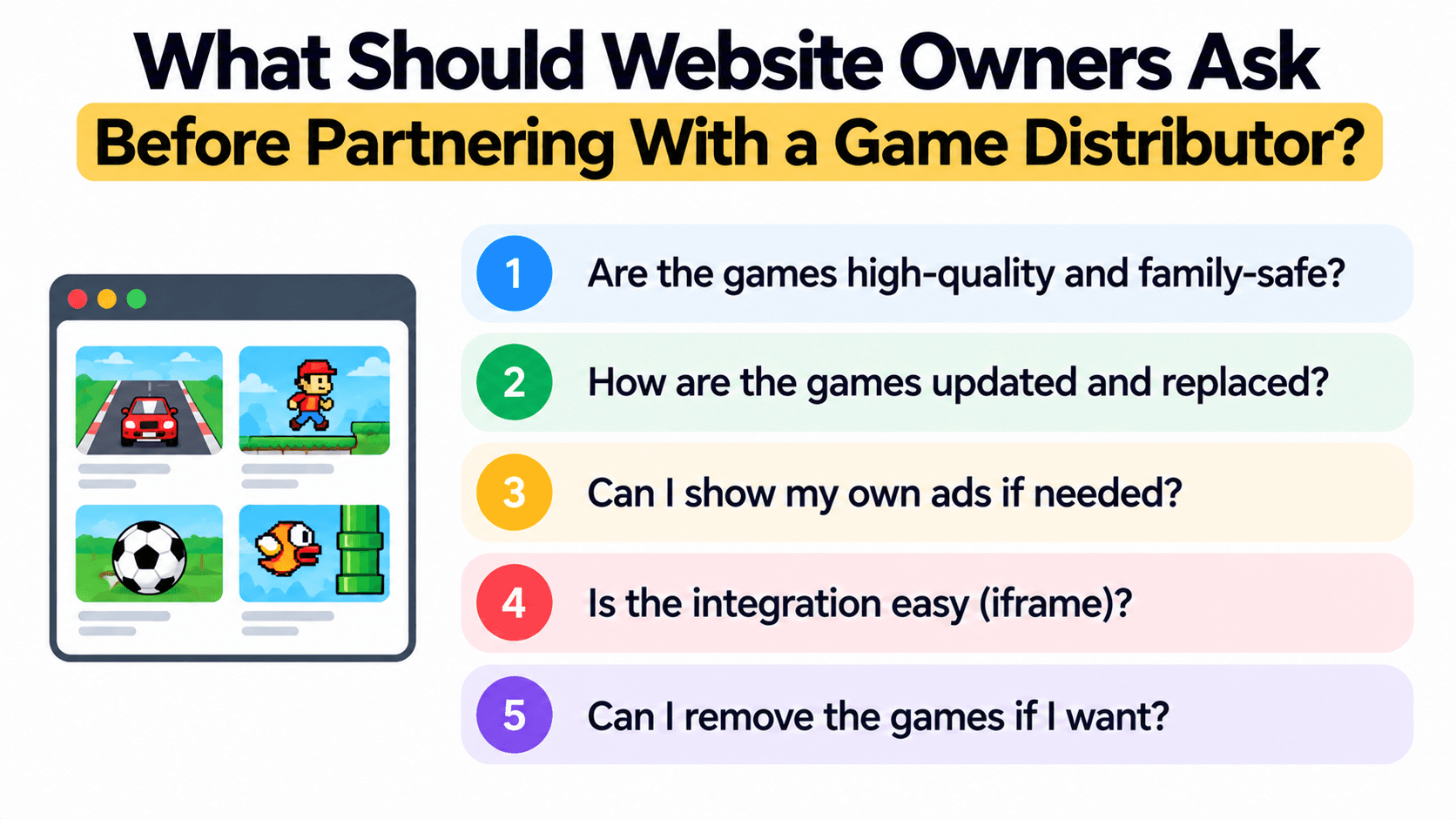
What Should Website Owners Ask Before Partnering With a Game Distributor?
Fourteen questions to put to any game distributor, grouped by what they protect, with the answer PlayKovo's published partner terms give for each one, so you can see what a clear answer looks like and compare any provider against it.
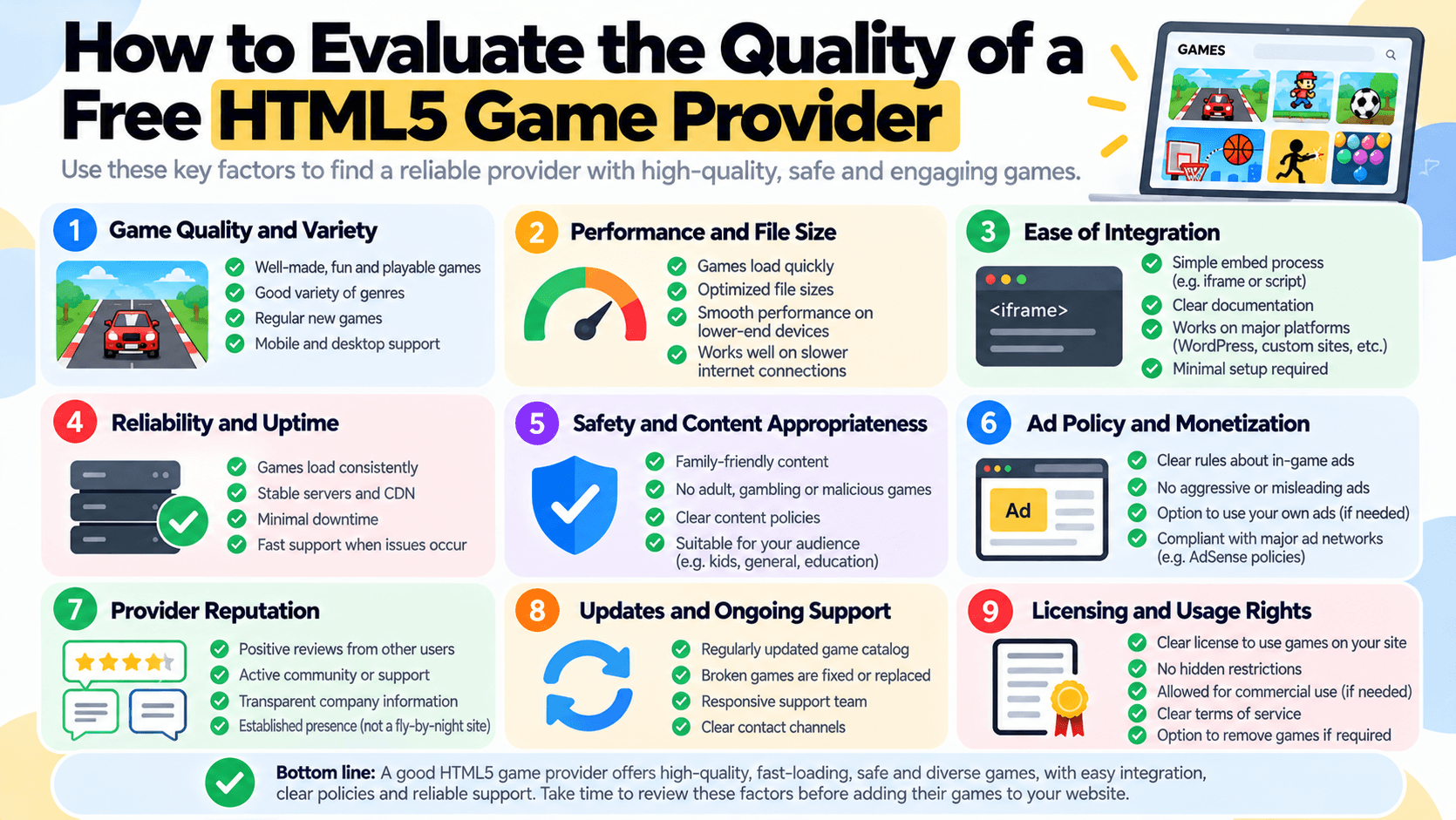
How to Evaluate the Quality of a Free HTML5 Game Provider
A weighted evaluation matrix you can copy, with tests you can run yourself for each criterion (feed completeness, embed health, framing, game weight, errors), and a worked example of the tests on PlayKovo's public feed. No competitors are scored.